Every January, Community Health Centers and FQHCs face the same convergence. The UDS submission deadline is approaching. Finance, operations, and reporting teams are comparing numbers, and the data definitions, schedule classifications, and supporting documentation do not line up cleanly.
The reconciliation that should have happened in October is happening in January, under deadline pressure, while clinical operations continue at full pace.
The problem is not the deadline. The problem is that the preparation started too late.
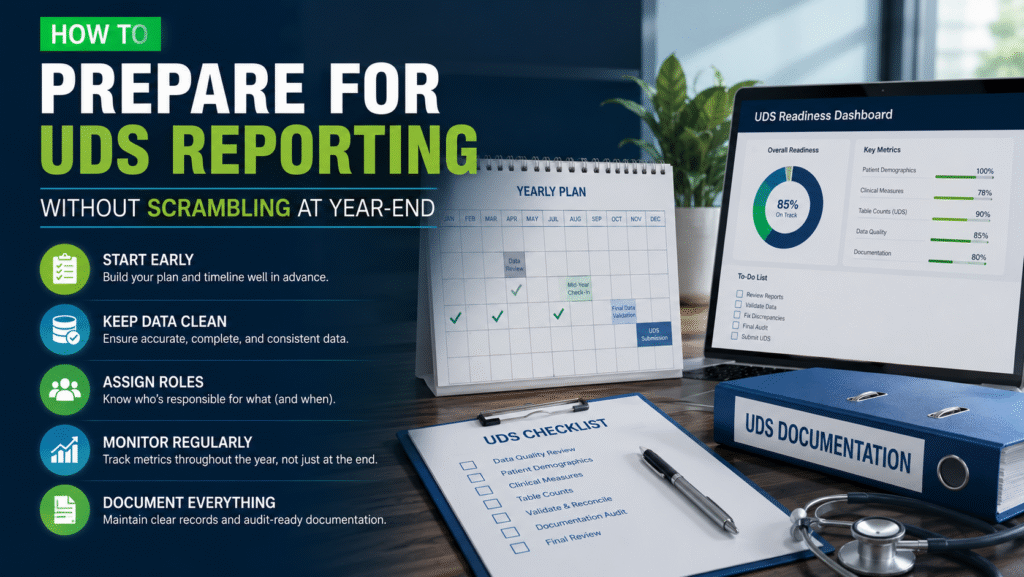
UDS reporting is not a single-department task that finance submits at year-end. According to the HRSA UDS Training and Technical Assistance hub, the 2025 UDS Manual provides health centers with “detailed reporting instructions and example data tables” covering 11 tables and 3 forms, capturing clinical, financial, and administrative performance across the entire organization. That scope reflects a reporting system that depends on aligned source data from billing, clinical operations, finance, and compliance simultaneously.
Health centers that treat UDS as a year-round reporting discipline, not a fourth-quarter cleanup project, enter submission season organized, reconciled, and in control.
What UDS Reporting Depends on Operationally
UDS reporting depends on 3 operational conditions: reliable source systems, consistent coding, and defined ownership across departments. When any of these 3 conditions is absent, year-end becomes a correction exercise rather than a reporting exercise.
1. Reliable source systems produce data that can be extracted, reconciled, and reported without manual reconstruction. The Electronic Health Record (EHR), the practice management system, and the general ledger must generate consistent outputs that agree with each other.
According to HRSA’s Reporting Guidance, HRSA provides an Offline Excel Mapping Tool specifically to help health centers “streamline reporting by providing mapped cell locations to data fields,” a tool that only functions correctly when the underlying source systems produce consistent, structured data throughout the year.
2. Consistent coding determines whether visit counts, patient classifications, revenue categories, and service type designations are recorded the same way in January as they are in November. Coding drift, where staff apply classifications inconsistently across the calendar year, produces variances that surface during UDS preparation and require manual correction at the worst possible time.
3. Defined ownership means that specific individuals in finance, billing, clinical operations, and compliance each know which UDS tables they are responsible for supporting. Health centers without defined ownership discovered during the reporting season that 3 different people assumed someone else was responsible for the same data element. Assign table ownership by department at the beginning of each calendar year, not at year-end.
What Finance Should Reconcile Before Year-End
Finance reconciliation for UDS readiness requires completing 4 specific reconciliations before December 31: revenue classifications, grant-related activity, patient service data tie-outs, and unusual variance analysis.
1. Revenue classifications must match the UDS financial reporting categories before the submission window opens. Patient service revenue, grant revenue, other program revenue, and non-patient-care income must each be classified correctly in the general ledger throughout the year. Reclassifying revenue in January, after the fiscal year has closed, is significantly more complex than maintaining correct classifications monthly.
2. Grant-related activity requires a grant-by-grant reconciliation confirming that all HRSA Health Center Program award expenditures are correctly classified and that unobligated balances are accurately stated.
The HRSA Health Center Program Compliance Manual, Chapter 15, requires health centers to maintain financial records containing “information about Federal awards, authorizations, obligations, unobligated balances, assets, expenditures, income, and interest, supported by source documentation.” These records feed directly into UDS financial tables. A finance team that maintains this documentation monthly produces accurate UDS financials without additional reconstruction.
3. Patient service data tie-outs connect the finance records to the clinical records. Total patient service revenue in the general ledger must reconcile to the volume and payer mix data reflected in the UDS. Gaps between these 2 figures indicate either coding inconsistency, billing errors, or classification issues. All of which require investigation and correction before submission.
4. Unusual variance analysis identifies items that will require explanatory notes or auditor attention. Revenue figures that differ materially from prior year without a documented operational reason, grant balances that do not match award letters, and payroll allocations that shifted between periods without corresponding time documentation all qualify as variances requiring pre-submission investigation.
Common Disconnects Between Finance and Program Reporting Teams
The 4 most common disconnects between finance and program reporting teams are misaligned visit definitions, inconsistent payer category classifications, unreconciled grant expenditure totals, and undocumented methodology for sliding fee scale revenue.
1. Don’t Assume Finance and Clinical Define “Visit” the Same Way
Finance teams count billable encounters. Clinical teams count all patient contacts, including encounters that generate no revenue. When these 2 counts diverge, the UDS visit totals and the financial revenue per visit calculations produce results that do not agree. This discrepancy surfaces during submission review and requires retroactive investigation across both systems.
Instead, You Should Align Visit Definitions Across Finance and Operations at the Start of Each Calendar Year
Establish a written definition of countable visits that both the EHR and the billing system apply consistently. Review the HRSA UDS Support Center resources, accessible at 866-UDS-HELP, which guide countable visit specifications for health centers with unique reporting needs.
2. Don’t Allow Payer Categories to Drift Between Systems
Medicaid, Medicare, sliding fee scale, and private insurance payer categories must be classified identically in the practice management system and the general ledger. When billing staff updates payer codes without corresponding updates to the general ledger mapping, the UDS financial tables and the patient characteristics tables report conflicting payer mix data.
Instead, You Should Run a Payer Category Reconciliation Quarterly
Compare payer classifications in the practice management system against the general ledger at least once per quarter. Identify and correct mismatches before they accumulate into a year-end reconciliation project.
3. Leave Grant Expenditure Totals Unreconciled Until Submission Season
Finance teams that reconcile grant expenditures only at year-end routinely discover that cost center allocations, indirect cost distributions, and program income adjustments have not been applied consistently. These discrepancies require retroactive correction under deadline pressure.
Instead, You Should Reconcile Each Grant Account Monthly Against Award Budgets
Monthly grant reconciliation confirms that expenditures are tracking within approved budget lines and that any rebudgeting requirements are identified and submitted to HRSA in advance per the requirements of 2 CFR 200.308.
4. Don’t Leave Sliding Fee Scale Revenue Methodology Undocumented
Sliding fee scale revenue adjustments represent a significant portion of health center revenue. When the methodology for calculating these adjustments is not documented, the UDS financial tables cannot be supported with traceable calculations, creating compliance exposure during site visits and audit engagements.
Instead, You Should Document the Sliding Fee Scale Revenue Calculation Methodology in Writing Each Year
Maintain a written policy describing how sliding fee discounts are calculated, applied, and recorded. Confirm the methodology aligns with the HRSA-approved sliding fee discount program before the year-end closes.
A Monthly or Quarterly Review Rhythm That Makes UDS Preparation Easier
UDS preparation difficulty is directly proportional to how infrequently finance and program teams compare their data during the year. Health centers that compare data monthly resolve small discrepancies before they compound. Health centers that compare data only at year-end inherit 12 months of accumulated mismatches.
A monthly review rhythm for UDS readiness requires 3 standing agenda items in every finance review meeting.
- First, confirm that the current month’s visit count from clinical operations agrees with the billable encounter count from the billing system. Document the reconciling items, such as non-billable visits or visits pending charge entry, and confirm they are classified correctly.
- Second, confirm that grant expenditures for the month are within approved budget lines and that any variances have been investigated.
- Third, confirm that payer mix classifications in the general ledger agree with the practice management system for the month.
A quarterly review rhythm adds 2 additional reconciliations.
Quarterly Reconciliation 1: Cumulative Patient Characteristics vs. Cumulative Financial Data.
At the end of each quarter, finance and program reporting leads compare the cumulative patient characteristics data against the cumulative financial data. This reconciliation confirms that payer mix, visit volume, and revenue per visit are internally consistent across both systems. A Medicaid patient count that has grown 12% quarter-over-quarter, for example, must reflect a corresponding increase in Medicaid revenue. A mismatch between these 2 figures indicates a coding inconsistency, a billing gap, or a classification error that requires investigation before it compounds further.
Quarterly Reconciliation 2: UDS Submission Checklist Review Against Current Data.
At the end of each quarter, the finance and reporting team runs through the HRSA UDS Submission Checklist, available through the HRSA reporting guidance hub, against the current quarter’s accumulated data. This checklist serves as a reference tool to help ensure a complete, accurate, and on-time UDS submission. Running it quarterly means that each data quality issue identified has a full quarter of remaining time for correction. The same issue identified in January has zero correction time.
The Financial Education & Research Foundation’s 2026 Financial Executives Priorities Report, capturing insights from more than 200 senior finance leaders, identifies operational efficiency and technology-enabled reporting as the top investment priorities for finance functions in 2026.
Only 15% of organizations report being fully prepared to support advanced analytics and reporting initiatives. Health centers that build monthly and quarterly review rhythms, regardless of technology investment level, develop the data quality foundation that makes advanced reporting possible.
Documentation Practices That Reduce Back-and-Forth During Reporting Season
Documentation practices that reduce UDS reporting back-and-forth require 4 standing files maintained throughout the calendar year: a grant expenditure log, a methodology file, a variance log, and a data definition dictionary.
1. The grant expenditure log documents every cost charged to each federal award, the budget line it was charged against, the supporting documentation reference, and the date it was reviewed. According to HRSA Compliance Manual Chapter 15, health centers must maintain financial records that identify the source and application of all federally-funded activity with source documentation. A continuously maintained grant expenditure log satisfies this requirement and eliminates the need to reconstruct grant documentation at year-end.
2. The methodology file documents the calculation basis for every significant estimate and adjustment in the financial statements, including sliding fee revenue adjustments, allowance for doubtful accounts, and accrued liabilities. Methodology documentation created during the year is more accurate and defensible than methodology reconstructed after the fiscal year closes.
3. The variance log records every material difference identified during monthly reconciliations, what the variance was, what caused it, how it was resolved, and when. This log transforms what would otherwise be unexplained year-end discrepancies into documented, resolved items with a traceable correction history.
4. The data definition dictionary records the agreed-upon definition of each UDS data element as applied at this specific health center, including how visits are counted, how payer categories are assigned, and how grant revenue is classified. This dictionary serves as the authoritative reference when staff turnover creates inconsistency in how data is recorded across the year.
How Outsourced Accounting Support Strengthens the Financial Side of UDS Readiness
Outsourced accounting support strengthens UDS’s financial readiness by ensuring that the monthly reconciliations, grant tracking, and financial classifications that UDS depends on are completed consistently, regardless of internal staff capacity, turnover, or competing operational priorities.
Most UDS reporting problems visible at year-end started in the monthly accounting cycle. Revenue misclassified in March is still misclassified in December. A grant account not reconciled in May carries unresolved variances into the UDS financial tables. Payroll allocations not reviewed in September require retroactive correction during submission season. Better monthly reporting produces better year-end reporting. This is not a complex principle. It is a process discipline that requires consistent execution.
According to the CPA Practice Advisor’s reporting on Gartner’s 2026 CFO budget priorities, nearly 60% of CFOs plan to increase finance function AI and technology investments by 10% or more in 2026, driven primarily by the need to automate reporting cycles and control operational costs.
For Community Health Centers operating with lean finance teams, outsourced accounting support delivers this operational efficiency without the capital investment required to build internal capacity. The same report notes that headcount growth expectations have collapsed from 6% in 2025 to just 2% in 2026, meaning that health centers cannot solve reporting discipline problems by simply hiring more staff.
An outsourced accounting partner that understands HRSA grant requirements, UDS financial table structures, and the compliance standards in HRSA Compliance Manual Chapter 15 provides the consistent monthly execution that makes submission season a documentation task rather than a crisis management exercise.
Final Opinion
Assess whether your current reporting rhythm is making UDS harder than it needs to be.
UDS reporting difficulty is a symptom. The underlying condition is a monthly reporting process that does not consistently produce reconciled, classified, and documented financial data.
Health centers that want submission season to feel manageable need to answer 3 questions honestly before the fourth quarter begins. First, do finance and clinical operations compare visit and payer data at least quarterly? Second, is every active grant account reconciled to its award budget monthly? Third, does a written methodology file exist for every significant financial estimate in the statements?
If the answer to any of these 3 questions is no, the scramble at year-end is not a reporting problem. It is a monthly process problem, and it is fully solvable before the next UDS cycle begins.
Sheikh, Osher & Scott CPAs & Advisors supports Community Health Centers and FQHCs with monthly accounting, grant reconciliation, and year-end financial preparation, structured to make UDS financial reporting straightforward rather than stressful. Schedule a reporting readiness assessment to evaluate whether your current monthly rhythm is setting your organization up for a clean submission.
References:
HRSA. UDS Reporting Guidance and Training Resources: bphc.hrsa.gov/data-reporting/uds-training-and-technical-assistance/reporting-guidance
HRSA. 2025 UDS Manual (PDF): bphc.hrsa.gov/sites/default/files/bphc/compliance/2025-uds-manual.pdf
HRSA. UDS Technical Assistance Hub: bphc.hrsa.gov/data-reporting/uds-training-and-technical-assistance
CPA Practice Advisor. CFOs to Prioritize Growth Functions, Technology, and AI in 2026: cpapracticeadvisor.com