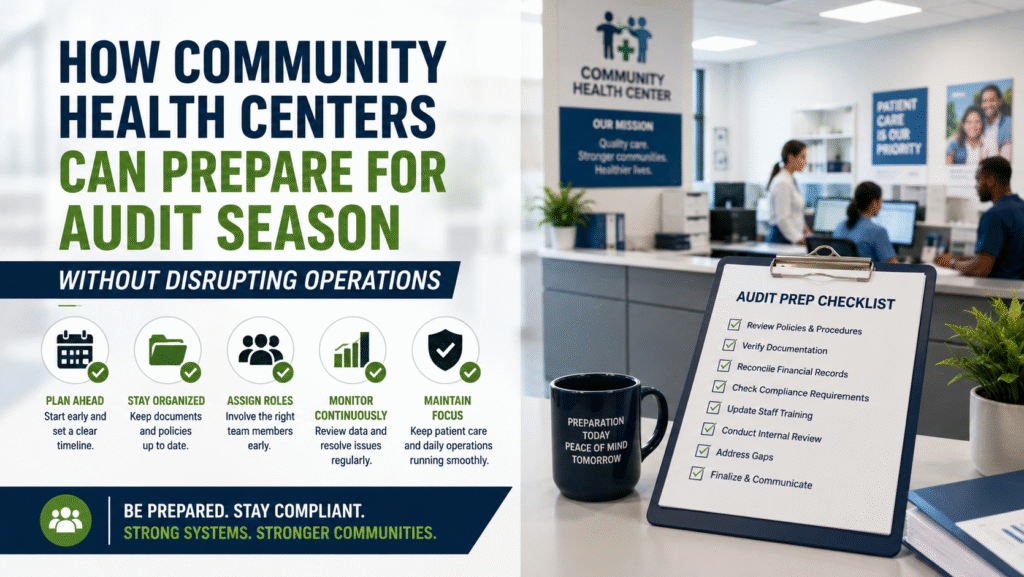
Audit season at a Community Health Center arrives in the middle of everything else. Patient scheduling runs at full capacity. Billing cycles are open. Grant reports are due. Staff are stretched across clinical, administrative, and compliance responsibilities simultaneously.
The audit does not pause any of that. The auditors arrive with a list of requests, and your finance team is expected to respond. On top of everything already on their plates.
The scramble is not inevitable. It is the result of preparation that starts too late.
Audit readiness is not a last-minute project.
According to the HRSA Health Center Program Compliance Manual, Chapter 15, health centers are required to maintain financial management and control systems that ensure “ongoing compliance with Federal statutes, regulations, and the terms and conditions of the Health Center Program award” year-round. That standard describes a discipline, not a deadline.
This guide is a goldmine for CHC and FQHC finance leaders who want to enter audit season organized, responsive, and operationally intact, as it covers the specific actions that reduce auditor follow-up, eliminate rework, and keep care delivery on track during fieldwork.
Decide Who Owns the Audit Internally Before the Auditors Ask
Audit preparation at Community Health Centers fails most often at the coordination level. The auditors send a request. Finance forwards it to billing. Billing sends it to operations. Operations does not know what is being asked. The item sits open for 2 weeks.
Assigning 1 internal audit coordinator before fieldwork begins eliminates this.
The audit coordinator is not responsible for producing every document. The coordinator owns 3 specific functions: receiving all auditor requests, tracking open items against a written timeline, and routing each request to the correct internal owner with a clear response deadline.
According to the HRSA Compliance Manual, Chapter 15, health centers must maintain financial management systems capable of identifying the source and application of all federal award funds and producing accurate, current, and complete financial disclosures. A single internal coordinator ensures that this documentation flows to auditors without delay, and without burdening clinical operations with requests they are not equipped to interpret.
The coordinator role works best when assigned to a finance manager or controller with direct access to grant records, payroll allocation schedules, and billing data. Assign this role at least 60 days before fieldwork begins.
Close the Basics Early Before the Request List Arrives
The following are 5 foundational schedules that auditors request first:
- Bank reconciliations
- Grant balances
- Accrued liabilities
- Payroll allocations
- Fixed asset listings
At most health centers, these schedules are prepared in response to the auditor’s request. They should be completed before the request arrives.
Closing the basics early removes the most common source of audit delay.
Bank reconciliations covering all operating, restricted, and grant accounts should be completed and reviewed for every month of the fiscal year before fieldwork begins. Unreconciled items discovered during audit fieldwork create findings. Unreconciled items discovered 60 days before fieldwork create time to fix them.
Grant balances require particular attention.
The HRSA Compliance Manual Chapter 15 requires health centers to maintain records containing information on “authorizations, obligations, unobligated balances, assets, expenditures, income, and interest” under each federal award. Each grant account balance should be reconciled to the general ledger and to any funder-submitted financial reports before the auditor arrives.
Payroll allocation schedules are among the most frequently questioned items in health center audits. Salary costs allocated across multiple grants, programs, and cost centers must be supported by time records and consistent with the HRSA-approved budget. Review and document these allocations before fieldwork. Not during it.
Fixed asset listings should reflect all acquisitions, disposals, and depreciation entries for the fiscal year. Auditors will test these against physical existence and proper classification. Have the schedule current before the engagement begins.
Organize Support for Revenue, Grants, Restricted Funds and Major Estimates
Revenue, grants, restricted funds, and major accounting estimates are the 4 areas where auditors spend the most time and where unsupported documentation creates the most significant delays.
Organizing support in these 4 areas before fieldwork cuts audit time and reduces follow-up requests by the largest margin.
- Revenue: Patient service revenue at FQHCs flows from multiple payers, including Medicaid, Medicare, sliding fee scale collections, and third-party insurers. Prepare a revenue reconciliation that ties the general ledger to UDS reporting and to any cost report submissions. Auditors will test this reconciliation. Have it ready before they ask.
- Grants: Each active federal grant requires a Schedule of Expenditures of Federal Awards entry and supporting documentation for all costs charged to the award. The HRSA Compliance Manual Chapter 15 requires written procedures confirming that “expenditures of Federal award funds are allowable in accordance with the terms and conditions of the Federal award.” Prepare a grant-by-grant expenditure summary with supporting invoices, payroll records, and approval documentation organized by award before the auditors begin testing.
- Restricted funds: Donor-restricted and board-designated funds require separate tracking. Prepare a schedule showing opening balances, additions, expenditures, and closing balances for each restricted fund. Confirm that restricted fund expenditures are consistent with the purpose for which the funds were received.
- Major estimates: Allowance for doubtful accounts, self-pay revenue adjustments, and any accrued liabilities based on estimates require documented methodology. Write down the basis for each significant estimate before the audit begins. Auditors will ask how the number was derived. Having a written answer prepared demonstrates control and reduces fieldwork time.
Build a Realistic PBC Timeline That Respects Operations
A Prepared By Client (PBC) list is the auditor’s document request list. At most health centers, the PBC arrives, and the team scrambles to respond while simultaneously managing clinical operations, billing deadlines, and grant reporting. This is the core operational disruption that preparation eliminates.
A realistic PBC timeline assigns internal due dates to every request item before the auditors set theirs.
Building a PBC timeline requires 3 steps:
First, obtain the prior year’s PBC list and use it as the baseline for the current year’s expected requests. Most requests repeat year to year.
Second, assign each item to a specific internal owner with a date that is 5 to 7 business days before the auditor’s deadline. This buffer absorbs review time and correction time without pushing past the auditor’s schedule.
Third, sequence the timeline around operational constraints. Grant report deadlines, payroll cycles, and board meeting dates should all be visible in the same calendar as the PBC due dates.
The Illinois CPA Society’s 2026 conference schedule, which includes the Not-for-Profit Symposium on June 4, 2026, the NFP Reporting Playbook on June 5, 2026, and the Advanced Not-for-Profit Conference on December 1, 2026, reflects the sector-wide recognition that financial management discipline and timeline planning are now primary leadership priorities, not back-office functions. Health center finance leaders who build structured PBC timelines operate with the same discipline that these professional forums are actively promoting across the sector.
Keep Management, Billing and Finance Aligned Throughout
Audit requests do not stay within the finance department. Auditors routinely request documentation from billing, clinical operations, human resources, and executive leadership. When these departments receive requests they do not understand, or when finance sends requests without context, items bounce between teams and arrive late.
Keeping management, billing, and finance aligned throughout the audit prevents the communication breakdown that delays most engagements.
Alignment requires 2 actions before fieldwork begins:
First, hold a pre-audit briefing with department heads from billing, HR, and operations. Explain what the auditors will request from each team, what the expected format is, and who the single internal contact is for routing questions.
Second, prepare a one-page summary of the audit timeline and key deadlines. Distribute it to every department that will be asked to produce documentation.
The Financial Education & Research Foundation’s 2026 Financial Executives Priorities Report, based on insights from more than 200 senior finance leaders, including CFOs, CAOs, and controllers, identifies operational efficiency and cross-functional alignment as defining priorities for finance organizations in 2026.
Only 15% of organizations report being fully prepared to support advanced analytics and data initiatives, a readiness gap that applies equally to audit documentation workflows. Health centers that invest in internal alignment before audit season avoid the coordination failures that create the other 85% of audit delays.
Use Weekly Status Tracking to Prevent Open Items From Piling Up
Open audit items accumulate silently. A request goes out. No one follows up. The auditor asks again. The internal owner finds out it was their responsibility. The item is now 10 days late and requires an expedited response that pulls resources from operations.
Weekly status tracking stops this pattern before it starts.
Weekly tracking requires a simple tool, a shared log or spreadsheet, that lists every open PBC item, the internal owner, the due date, and the current status. The audit coordinator reviews this log every week and identifies items at risk of missing their deadline. Items that are more than 3 days from their due date without a draft response receive a direct follow-up.
According to the HRSA Compliance Manual Chapter 15, health centers must demonstrate the capacity to “track the financial performance of the health center, including identification of trends or conditions that may warrant action.” Weekly audit status tracking applies this same management principle to the audit engagement itself. Open items are trends. Accumulating open items is a condition that warrants action before they delay sign-off.
The tracking log also serves a secondary purpose. It creates a documented record of response dates and item completions that the audit coordinator can share with auditors if questions arise about the timing of any submission.
Final Thoughts
Community Health Center audit preparation reduces to 1 principle: decisions made 60 to 90 days before fieldwork determine whether audit season disrupts operations or runs alongside them.
Therefore, run a pre-audit readiness review 60 to 90 days before fieldwork!
Assign the internal coordinator now. Close the foundational reconciliations now. Organize grant documentation and revenue support now. Build the PBC timeline before the auditors send theirs. Align the departments that will be asked to contribute. Track open items weekly from the first request to final sign-off.
The HRSA Health Center Program Compliance Manual Chapter 15 establishes that sound financial management is a standing program requirement. Not an audit-year activity. Health centers that operate accordingly enter fieldwork already compliant, already organized, and already in control of the timeline.
Sheikh, Osher & Scott CPAs & Advisors structures audit engagements specifically for Community Health Centers and FQHCs, with clear request lists, realistic timelines, and direct communication so your team knows what is needed, when it is needed, and who needs to act. Schedule a pre-audit readiness consultation 60 to 90 days before your fieldwork begins.
References:
- HRSA Health Center Program Compliance Manual. Chapter 15: Financial Management and Accounting Systems: bphc.hrsa.gov/compliance/compliance-manual/chapter15
- HRSA Health Center Program Compliance Manual. Main Manual: bphc.hrsa.gov/compliance/compliance-manual
- Illinois CPA Society. 2026 Conferences Overview: icpas.org/education/programs/conferences
- CPA Practice Advisor. Financial Executives Prioritize Technology, AI, and Disciplined Growth in 2026: cpapracticeadvisor.com